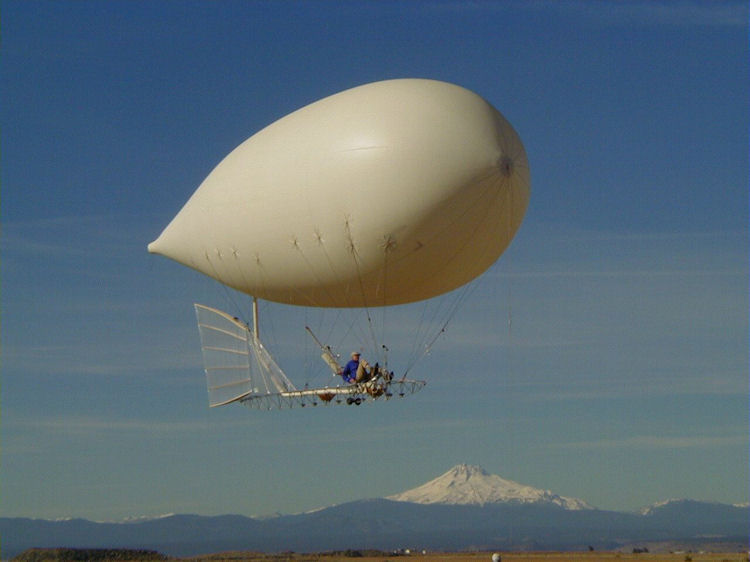
Richard Tetz pilots a balloon that flys well, but where are the wings?
You could get even more performance!
WHITE DWARF SPECS
Year built: 1985
Designed and built by: Bill Watson
Built for: Gallagher, the comedian
Dimensions
Envelope length: 48'
Maximum diameter: 17'
Volume: 6200 cubic feet
Overall height: 27"
Weights
Empty: 140 lbs.
Pilot weight range: 90-250 lbs.
Maximum take-off weight: 390 lbs.
Performance
Maximum level speed: 12 mph
Average cruising speed: 6-7 mph
Construction
Envelope: Helium filled, non-rigid polyurethane coated nylon.
Helium maintained at average slight pressure of 0.02 lbs/sq. in. No ballonets.
Fuselage: Open framework structure of 2024 T3 and 7075 T6 aluminum, stressed to 4+ Gs,
attached to the envelope by 24 Dacron sheathed Kevlar lines.
Ballasting: two water ballast tanks with pilot-controlled drains and up to 60 lbs. of lead
ballast control buoyancy.
Venting: A three-inch diameter plug
alongside the seat can be lifted by the pilot to vent helium. It opens automatically at a pressure of 4 inches of water.
Aerodynamic controls: Large Mylar covered styrofoam and spruce rudder.
Passengers: pilot only
Power system: Pedal power, producing approx. 10 lbs. of cruise
thrust via 4:1 gearing and plastic chain drive to a two-blade pusher propeller made of spruce and Styrofoam.
Propeller can be vectored up and down for vertical control.
Misc.
Cost to fill: approx. $1000.00
FAI World for Duration, Class B Airships, BA-1 through BA-10, achieved by pilot Bryan Allen in 1985.
Here is a different one.